
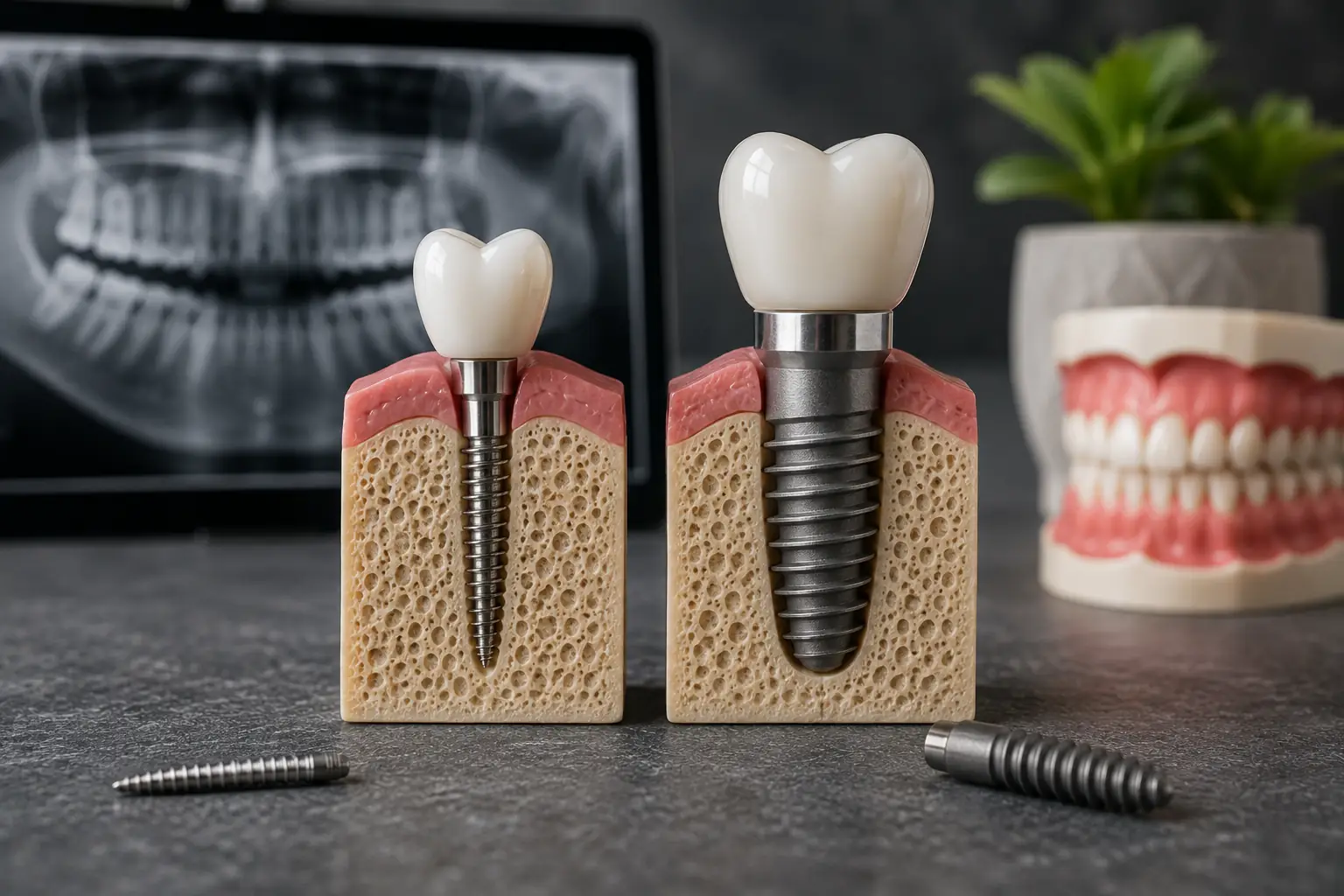
Mini dental implants use a titanium post roughly half the diameter of a traditional implant, which allows for a less invasive procedure, often without bone grafting. They generally cost less and heal faster than traditional implants, but they aren’t the right fit for every situation. The best option depends on your bone density, budget, and what you’re replacing.
The Core Difference: Size
A traditional dental implant is a titanium post, typically around 3.5 to 6 millimeters wide, that’s surgically placed into the jawbone to act as an artificial tooth root. A mini dental implant uses the same basic concept with a post roughly half that diameter, generally under 3 millimeters. That difference in size is what drives nearly every other difference between the two options: how much bone is needed, how invasive the procedure is, how quickly you heal, and in some cases, how much treatment costs.
Because a mini implant is narrower, it can often be placed in areas where there isn’t enough bone width for a traditional implant, without needing a bone graft first. That makes mini implants a meaningful option for patients who were told in the past that bone loss ruled out implants entirely.
Comparing the Procedure
Traditional implant placement typically involves a small incision in the gum tissue to access the bone directly, and healing before the implant can support a restoration often takes three to six months. Mini implants are placed with a less invasive technique, sometimes without incisions at all, and can frequently support a restoration the same day or shortly after placement rather than requiring the same extended healing period.
That faster timeline is appealing, but it comes with a trade-off worth understanding: because mini implants are narrower, they generally aren’t recommended for supporting the same amount of chewing force as a full-size implant, particularly for replacing back teeth that handle heavy chewing.
Comparing Cost
Mini dental implants are generally less expensive than traditional implants, largely because the procedure is simpler and often avoids the additional cost of a bone graft. For patients working with a tighter budget, or those who need to stabilize a loose denture without committing to full traditional implant treatment, that cost difference can be significant.
Who’s a Better Fit for Mini Implants
Mini implants tend to be a strong option for:
* Patients who don’t have enough bone width for a traditional implant and want to avoid bone grafting* Patients looking to stabilize a lower denture that currently relies on adhesive* Patients replacing a single tooth or a few teeth where less chewing force is involved* Patients who want a shorter treatment timeline* Patients working with a more limited budget
Who’s a Better Fit for Traditional Implants (or All-on-4)
Traditional implants, or All-on-4 (https://desertdentalalternatives.com/blog/all-on-4-dental-implants-cathedral-city) for full-arch replacement, are generally the better choice when:
* You’re replacing back teeth that handle significant chewing force* You have adequate bone density and want the strongest, most durable long-term option* You’re replacing most or all of the teeth in an arch and need a fixed, full-arch solution* Long-term durability is a higher priority than a faster timeline or lower upfront cost
Neither option is universally “better.” The right choice depends on where in the mouth you’re replacing teeth, how much bone is available, and what you’re trying to accomplish, which is why an exam and imaging are part of every implant consultation.
What the Procedure Looks Like
For mini implants, treatment typically starts with an exam and digital imaging to confirm there’s enough bone width and to plan implant placement. The implant is then placed, often without the incision required for traditional implants, and in many cases a denture or crown can be attached the same day or shortly after. Full healing continues over the following weeks even after the restoration is attached.
Living With Mini Implants
Once healed, mini implants function similarly to traditional implants for daily use: brushing, flossing around the implant site, and routine dental visits keep the surrounding gum tissue healthy. Patients using mini implants to stabilize a denture typically notice an immediate improvement in stability and confidence, since the denture clips onto the implants rather than relying on adhesive that can loosen throughout the day.
Getting a Straight Answer for Your Situation
Because bone density and the number of teeth being replaced vary so much from patient to patient, the only reliable way to know whether mini implants, traditional implants, or full-mouth reconstruction (https://desertdentalalternatives.com/blog/full-mouth-reconstruction-process) fits your case is a consultation with digital imaging. Schedule an exam (https://desertdentalalternatives.com/contact-us/) at Desert Dental Alternatives in Cathedral City to find out which option makes sense for you.
Day-to-Day Life With Each Option
Once healed, the daily experience of mini and traditional implants is fairly similar: both are cared for with regular brushing, flossing around the implant site, and routine dental visits. The bigger day-to-day difference shows up during the healing period. Because mini implants are placed with a less invasive technique, many patients return to normal activities and a regular diet faster than they would after traditional implant surgery. Patients using mini implants to stabilize a denture also typically notice an immediate, tangible difference: no more repositioning a loose denture throughout the day or managing adhesive that wears off by evening.
What Determines the Final Cost
Beyond the general cost difference between mini and traditional implants, your final price depends on how many implants are needed, what type of restoration is being attached, whether any teeth need to be removed first, and whether additional imaging or planning is required. Financing options (https://desertdentalalternatives.com/payment-options/) are available to help spread the cost of either option over time, which is worth discussing during your consultation alongside the clinical comparison.
Serving Patients Across the Coachella Valley
Desert Dental Alternatives evaluates implant candidates from Cathedral City and the surrounding area, including Palm Desert, Indio, and La Quinta, using the same digital imaging and exam process regardless of which implant option ends up being the right fit.
What Happens if Neither Option Fits Perfectly
Some patients don’t fall neatly into either category. You might have enough bone for a traditional implant in one area of your mouth but not another, or you might be replacing several teeth across an arch rather than just one or two. In situations like this, your dentist may recommend a mixed approach, using mini implants in one area and traditional implants in another, or combining implant types as part of a broader full-mouth reconstruction (https://desertdentalalternatives.com/blog/full-mouth-reconstruction-process) plan. This is one of the main reasons a one-size-fits-all recommendation doesn’t work well for implant treatment, and why imaging-based planning matters more than picking an implant type in advance. Schedule a consultation (https://desertdentalalternatives.com/contact-us/) to get a personalized recommendation based on your own imaging rather than guessing which option fits.
FAQs
Mini implants are generally not recommended for the same level of chewing force as traditional implants, which is why they’re most often used for stabilizing dentures or replacing front teeth rather than back teeth that handle heavy chewing.
With good oral hygiene and regular dental visits, mini implants can last many years, though traditional implants are generally considered more durable for high-chewing-force areas over the long term.
Yes. One of the most common uses for mini implants is stabilizing a lower denture that currently relies on adhesive, giving it a secure connection point without the cost or healing time of traditional implants.
Generally yes. Many mini implant procedures allow a restoration to be attached the same day or shortly after placement, while traditional implants typically need three to six months to fully integrate with the jawbone before a permanent restoration is placed.
In some cases, yes, though it depends on the amount of bone available and the specific situation. This is worth discussing during your consultation if you’re unsure which option is the better long-term fit.